
Comprehensive Guide to PCR Controls: Positive, Internal, and No Template Controls
Comprehensive Guide to PCR Controls : Positive, Internal, and No Template Controls
Polymerase Chain Reaction (PCR) is a cornerstone of molecular biology, used to amplify DNA for research, diagnostics, and clinical applications. Among the critical PCR controls are the PCR Positive Control, Internal Positive Control, and No Template Control (NTC). These controls ensure the accuracy of the test results, help validate negative results, and eliminate the possibility of contamination. In this article, we explore PCR positive control, internal positive control, no template control, and the significance of each in PCR assays.
What Are PCR Controls?
PCR controls are essential components of every PCR experiment. They help verify that the PCR reaction worked correctly, rule out contamination, and confirm that negative results are genuine. Common types of PCR controls include PCR positive control, internal positive control (positive internal control), and no template control (NTC control, PCR non template control).
PCR Positive Control: Definition and Importance
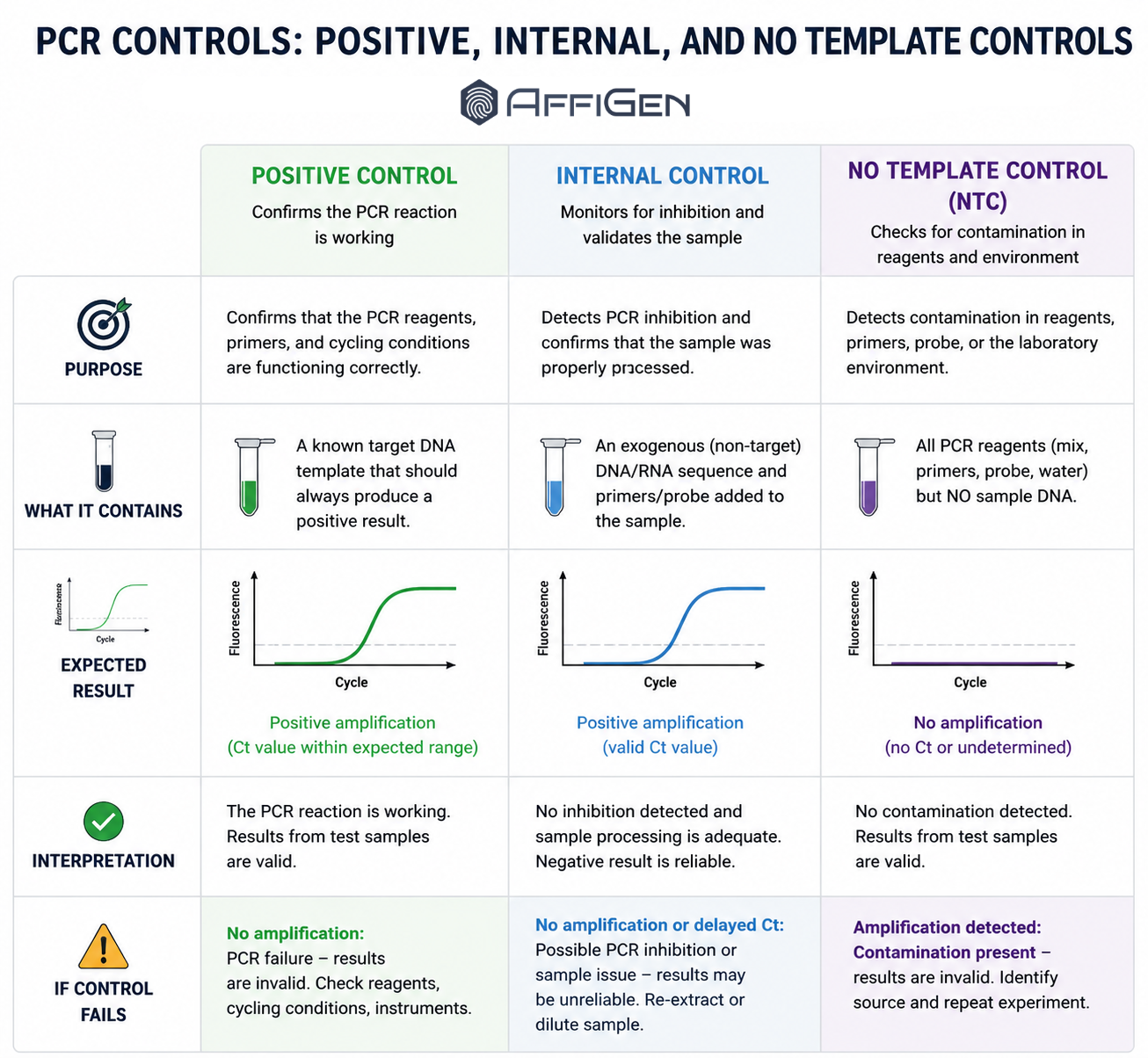
A PCR positive control contains a known template DNA that should always produce a positive amplification signal. Its purpose is to confirm that the PCR reagents, thermocycler, and primers are functioning properly. Without a positive control in PCR, it is impossible to differentiate between a true negative sample and a failed reaction. Using a positive control for PCR ensures that the experiment is reliable and that any negative sample result is accurate, so by adding a positive control in the PCR process, researchers can be confident that the experimental setup is functioning properly.
Internal Positive Control: Ensuring Accuracy and Reliable Results
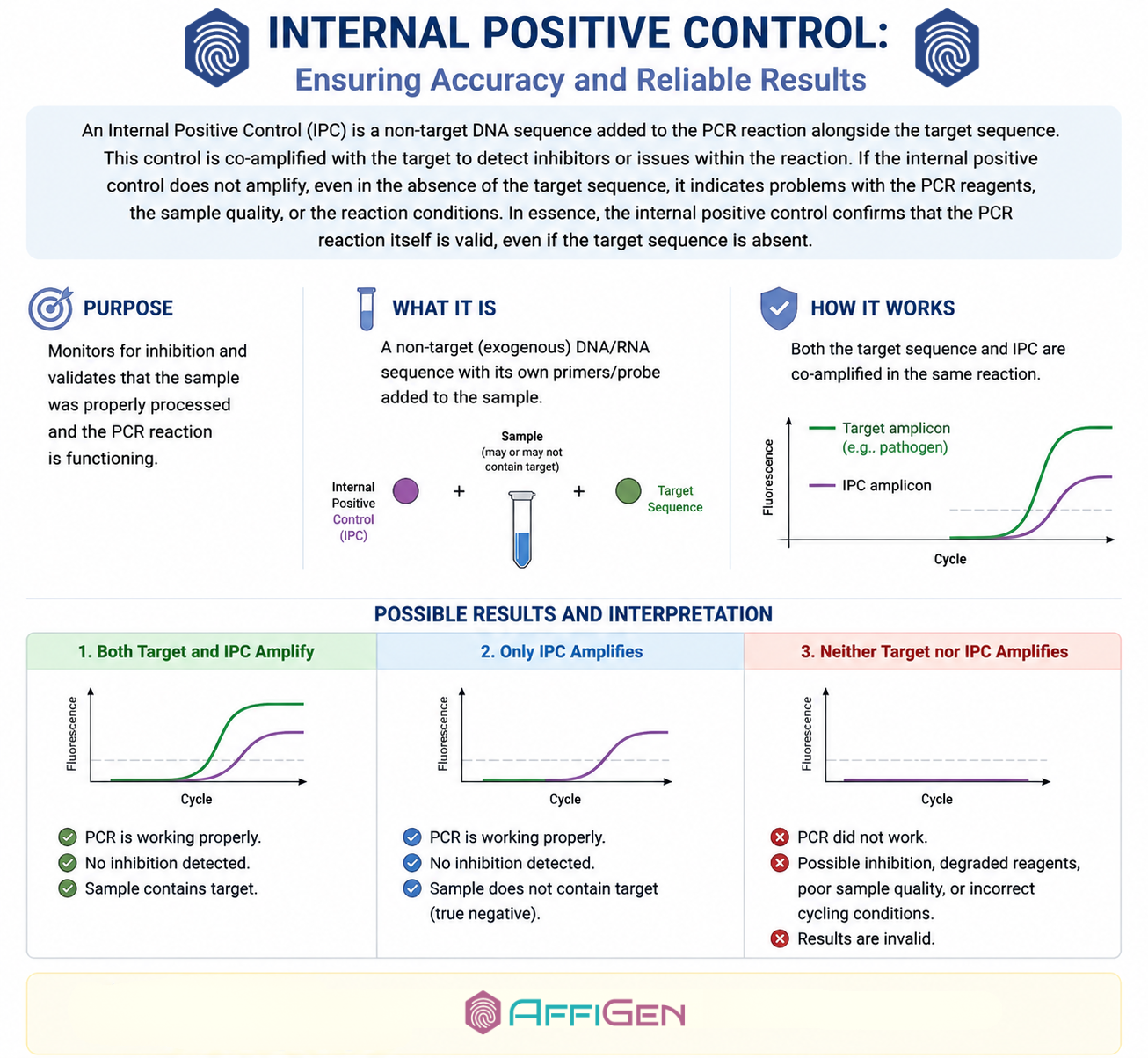
An internal positive control, also called a positive internal control or internal control positive, is a non-target DNA sequence added to the PCR reaction. It is co-amplified with the target sequence to monitor for inhibitors or reaction failures. If the internal positive control fails to amplify, even when the target is absent, it indicates a problem with the PCR reagents or sample quality. Internal control PCR ensures confidence in negative results. In real-time PCR, an internal control positive signal confirms the PCR reaction is valid. Understanding what internal control positive means is crucial for interpreting results correctly.
No Template Control (NTC) in PCR : Contamination Detection
A no template control (NTC control, PCR non template control, no template control PCR) contains all PCR reagents except the template DNA. It ensures that observed amplification is not due to contamination. Any signal in a no template control indicates contamination, requiring the experiment to be repeated. Using controls for PCR such as NTCs helps maintain assay accuracy and reliability.
The Importance of Controls in PCR : What Does “Positive” Mean in PCR Controls?
The term positive in PCR controls signifies a successful amplification signal. A positive control in PCR confirms that reagents and thermal cycling work correctly. An internal positive control confirms the PCR reaction is functional, even if the target DNA is absent. A positive internal control ensures that negative sample results are reliable. Confirmed PCR results depend on proper positive controls. Understanding the meaning of positive internal control and internal positive control helps in interpreting PCR outcomes.
How to Interpret PCR Control Results?
Understanding the results of your PCR controls is essential. A positive control confirms successful amplification, ensuring that all reagents and equipment are functioning properly. Internal positive controls provide confidence that the PCR reaction is valid even if the target DNA is not present, while no template controls help identify contamination. Proper interpretation of these results is critical to distinguishing true negative results from technical errors.
Conclusion: The Role of Controls in Reliable PCR Results
Implementing the right controls in PCR, including positive controls, internal controls, and no template controls, is fundamental for ensuring the accuracy and reliability of PCR assays. Internal positive controls ensure that the reaction is valid even in the absence of the target, while positive controls confirm the functionality of reagents and equipment. NTCs help detect contamination, ensuring that the results are not compromised. Understanding the meaning of internal control positive and positive control PCR is vital to the successful application of PCR in both research and clinical diagnostics.
Function of Template DNA in PCR
The template DNA provides the sequence that will be amplified during PCR. Without template DNA, the PCR reaction cannot generate a product. That’s why both positive controls and internal controls are critical they ensure that the function of template DNA in PCR is verified. The PCR template works alongside internal control positive mean to confirm reaction validity.
Endogenous and Negative Internal Controls
Some PCR assays include endogenous controls, which are naturally present genes used as internal positive controls. Negative controls, including NTCs, help detect contamination and verify assay specificity. Understanding negative internal control positive meaning and true negative results is essential for accurate PCR interpretation.
Summary
Using PCR controls including PCR positive control, internal positive control, and no template control is essential to ensure accuracy, reproducibility, and reliability in PCR assays. Positive controls verify that reagents and equipment work correctly. Internal positive controls detect inhibitors and validate negative results. No template controls detect contamination. Together, these controls make PCR a trusted method for research and clinical diagnostics. Proper use of PCR controls, understanding what internal control positive means, and confirming PCR results are the foundation of reliable molecular biology experiments.
Insights on PCR Controls and Interpretation
Understanding PCR controls is fundamental for ensuring reliable experimental outcomes. A positive internal control plays a critical role in validating each reaction by confirming that amplification conditions are functioning correctly. In many assays, the presence of an internal control positive signal ensures that even when the target is absent, the PCR reaction itself remains valid.
A PCR positive control (also referred to as a positive PCR control or positive control in PCR) is essential to confirm that the amplification system is working. Without a proper positive control for PCR, it becomes difficult to determine whether a negative result is truly negative or due to reaction failure. This is why using a positive control PCR setup is considered a best practice in all molecular workflows.
Equally important is the no template control (no template control PCR), sometimes called a non template control. This control ensures that there is no contamination in reagents or the environment. If amplification appears in the no template control, it indicates contamination, and the experiment must be reviewed. Using multiple controls for PCR, including both positive and negative setups, strengthens data reliability.
A frequent question is: what does internal positive control mean or what does internal control positive mean? In simple terms, it indicates that the PCR system is functioning correctly, even if the target DNA is not detected. Similarly, understanding what does positive internal control mean helps researchers interpret results accurately and distinguish between true negatives and technical failures.
The concept of positive control vs negative control is also crucial. While a positive control in PCR confirms successful amplification, negative controls such as no template control verify that no contamination has occurred. In some cases, interpreting results like negative (internal control positive) or understanding negative internal control positive meaning is essential. These results typically indicate that the target is absent, but the reaction itself worked correctly due to a valid internal control PCR signal.
Overall, implementing a robust PCR internal control strategy including control for PCR, PCR control, and multiple PCR controls ensures high-quality, reproducible results. A strong understanding of internal control positive mean and correct interpretation of control outcomes is key to accurate molecular diagnostics and research success.
Recent Posts
-
E. coli Protein Expression: Complete Guide to Recombinant Protein Expression in Escherichia coli
E. coli Protein Expression: Complete Guide to Recombinant Protein Production in Escherichia coli Int …17th Jun 2026 -

Bacterial DNA Extraction Kit | Bacterial Genomic DNA Extraction & DNA Isolation from Bacteria
Bacterial DNA Extraction and Bacterial Genomic DNA Extraction Kit for DNA Isolation from Bacteria W …17th Jun 2026 -
comparison of pcr with other nucleic acid amplification techniques
NAAT vs PCR: What Is the Difference Between NAAT and PCR Testing? Introduction The comparison of NAA …15th Jun 2026