
Sanger Sequencing
Sanger Sequencing: Principle, Method, Workflow and the Role of Touchdown PCR
Solix Biosystems offers a range of engineered DNA polymerases for upstream DNA amplification and downstream finishing for Sanger DNA sequencing applications.
Solix HotStart DNA Polymerase offers faster and more efficient Hot Start PCR than competitor enzymes based on wild-type Taq.
Fast HotStart DNA Polymerase is an engineered DNA polymerase designed specifically for high-throughput, high performance Fast PCR.
Solix Robust HotStart DNA Polymerase is a novel DNA polymerase derived from wild-type Taq through molecular evolution, and is specifically designed for high performance PCR in chemically complex environments. The enzyme is resistant to many inhibitors commonly found in crude samples and is ideally suited for the routine amplification of difficult templates (i.e. GC-rich) and samples. The increased processivity and specific activity of HotStart allows for improved PCR success rates across diverse primer sets and sample types.
Solix Long Range HotStart DNA Polymerase is recommended for the amplification of long templates perfect for sequence gap closure. The fidelity of Solix Long Range HotStart is 3x – 6x improvement over Taq polymerase.
Sanger Sequencing: Principle, Method, Workflow and the Role of Touchdown PCR
Sanger sequencing is a DNA sequencing method used to determine the nucleotide order of a defined DNA fragment. Also known as the chain-termination method, it uses DNA polymerase, standard deoxynucleotides (dNTPs) and chain-terminating dideoxynucleotides (ddNTPs) to generate DNA fragments that can be separated and analyzed to reconstruct the sequence of a DNA template.
First described by Frederick Sanger, Steven Nicklen and Alan Coulson in 1977, the method remains widely used for targeted DNA analysis, plasmid verification, PCR product sequencing, mutation confirmation and sequence validation.
What Is Sanger Sequencing?
Sanger sequencing is a targeted DNA sequencing technique based on controlled termination of DNA synthesis.
During the sequencing reaction, DNA polymerase extends a primer along a DNA template using normal nucleotides. Occasionally, a fluorescently labeled dideoxynucleotide triphosphate (ddNTP) is incorporated instead of a conventional nucleotide.
Because ddNTPs lack the 3′ hydroxyl group required for continued DNA strand elongation, their incorporation terminates synthesis at that position.
The reaction therefore creates a collection of DNA fragments of different lengths, each ending at a particular nucleotide.
Modern instruments separate these fragments according to size by capillary electrophoresis and detect their fluorescent labels. The resulting signals are converted into a DNA sequence.

Sanger sequencing l Wikipedia
How Does Sanger Sequencing Work?
The modern Sanger sequencing method can be divided into several major stages :
- DNA template preparation
- PCR amplification when required
- PCR product purification
- Cycle sequencing
- Sequencing reaction cleanup
- Capillary electrophoresis
- Electropherogram analysis
- Sequence interpretation
Each stage influences the quality and reliability of the final DNA sequence.
Step 1: DNA Template Preparation
The starting material for Sanger DNA sequencing may include:
- purified plasmid DNA
- PCR amplicons
- cloned DNA fragments
- genomic regions amplified by PCR
- cDNA-derived amplification products
- other purified DNA templates.
Template purity is important because salts, residual primers, nucleotides, proteins and other contaminants may interfere with downstream sequencing reactions.
When the amount of target DNA is limited, PCR is commonly used to generate sufficient template before sequencing.
Step 2: PCR Amplification Before Sanger Sequencing
PCR amplification is frequently used upstream of Sanger sequencing to selectively enrich the DNA region of interest.
The quality of the PCR product is particularly important.
Ideally, amplification should generate one strong, specific amplicon corresponding to the intended target sequence.
If several products are generated, the sequencing reaction may contain multiple overlapping templates. This can produce mixed fluorescent signals and make the resulting electropherogram difficult to interpret.
For this reason, PCR specificity can directly affect Sanger sequencing quality.
Why PCR Specificity Matters for Sanger Sequencing?
Sanger sequencing generally works best when a sequencing reaction contains a homogeneous DNA template.
Non-specific amplification may result in:
- overlapping chromatogram peaks
- ambiguous base calls
- elevated background signal
- reduced usable read length
- difficult sequence alignment
- inaccurate interpretation around variable positions.
Optimizing the upstream PCR reaction is therefore an important step in obtaining clear sequencing data.
Several parameters can influence PCR specificity, including:
- primer design
- annealing temperature
- magnesium concentration
- template quality
- polymerase performance
- extension conditions
- cycle number
- reaction inhibitors
One strategy for improving amplification specificity is touchdown PCR.
What Is Touchdown PCR?
Touchdown PCR is a PCR strategy in which the annealing temperature starts above the expected optimal primer annealing temperature and is progressively lowered during successive amplification cycles.
The early cycles therefore occur under relatively stringent conditions that favor highly specific primer-template interactions.
As amplification continues, the annealing temperature gradually decreases, allowing efficient amplification of the correctly initiated target DNA.
The objective is to improve the balance between PCR specificity and amplification yield.
How Does Touchdown PCR Work?
A typical touchdown PCR program begins with an annealing temperature several degrees above the calculated melting temperature of the primers.
The annealing temperature is then progressively reduced across successive cycles.
A simplified workflow may look like:
Initial denaturation
↓
High-stringency annealing temperature
↓
Progressive decrease in annealing temperature
↓
Amplification at the final annealing temperature
↓
Final extension
The exact temperatures, number of cycles and temperature decrease must be optimized according to the primers, DNA template and polymerase system being used.
Published touchdown PCR approaches commonly begin approximately 5–10°C above the calculated primer melting temperature, followed by gradual decreases toward a more permissive annealing temperature.

Summary of the touchdown PCR protocol l ResearchGate
Why Does Touchdown PCR Improve Specificity?
During the first PCR cycles, a higher annealing temperature makes imperfect primer-template interactions less favorable.
Correctly matched primer-template hybrids are more likely to form and undergo amplification.
Once the desired product has been generated during the early cycles, it becomes an increasingly abundant template for subsequent amplification.
This creates an amplification advantage for the intended target over many non-specific products.
Touchdown PCR can therefore be useful when conventional PCR produces:
- multiple amplification bands
- weak target amplification
- non-specific amplification
- difficult GC-rich templates
- closely related potential targets
- challenging primer-template combinations.
Touchdown PCR and Hot Start PCR
Hot Start PCR and touchdown PCR address complementary aspects of amplification specificity.
Hot Start DNA polymerases are designed to reduce polymerase activity during reaction preparation and before thermal activation. This can help limit undesirable amplification initiated at lower temperatures.
Touchdown PCR instead controls specificity through the annealing-temperature profile.
Combining an appropriate Hot Start DNA polymerase with a carefully optimized touchdown PCR program can therefore be useful when high specificity is required for difficult DNA amplification workflows.
This can be particularly relevant when PCR products will subsequently be analyzed by Sanger sequencing.

Hot Start PCR l ScienceDirecte
Touchdown PCR Protocol: General Experimental Framework
There is no universal touchdown PCR protocol suitable for every primer pair or DNA template. However, a general experimental framework can be described as follows.
1. Initial Denaturation :
The DNA template is denatured so that the complementary strands separate.
2. High-Stringency Touchdown Cycles :
The first annealing temperature is selected above the expected optimal primer annealing temperature.
During successive cycles, the annealing temperature is progressively reduced.
For example, a laboratory may experimentally evaluate a temperature decrease of approximately 0.5–1°C per cycle, depending on the primer system and assay design.
3. Constant-Temperature Amplification :
After reaching the selected final annealing temperature, additional amplification cycles may be performed at that temperature to increase product yield.
4. Final Extension :
An appropriate final extension step allows synthesis of remaining incomplete DNA strands.
The optimal touchdown PCR program should always be experimentally validated for the polymerase, primers and template being studied.
How Touchdown PCR Can Support Sanger Sequencing?
Touchdown PCR can be valuable upstream of Sanger sequencing because sequencing quality depends heavily on the purity and specificity of the amplified template.
A successful workflow can be represented as:
DNA sample
→ Specific PCR amplification
→ PCR product purification
→ Sanger cycle sequencing
→ Capillary electrophoresis
→ Electropherogram
→ DNA sequence
When conventional PCR generates several competing amplicons, improving amplification specificity before sequencing may significantly simplify downstream sequence interpretation.
Step 3: PCR Product Purification
After amplification, residual components should generally be removed before the sequencing reaction.
These may include:
- unused primers
- unincorporated dNTPs
- salts
- enzymes
- unwanted reaction components.
Purification can be performed using approaches such as enzymatic cleanup or column-based purification.
The objective is to provide a sufficiently clean DNA template for the cycle sequencing reaction.
Step 4: Sanger Cycle Sequencing
Cycle sequencing resembles PCR thermal cycling but has an important difference:
Sanger cycle sequencing normally uses one sequencing primer rather than a pair of forward and reverse primers.
The reaction typically contains:
- purified DNA template
- one sequencing primer
- DNA polymerase
- conventional dNTPs
- fluorescently labeled ddNTPs
- appropriate reaction buffer
During repeated denaturation, primer annealing and extension steps, DNA fragments of different lengths are generated.
Each fragment terminates when a fluorescent ddNTP becomes incorporated.
What Are ddNTPs in Sanger Sequencing?
The four chain-terminating nucleotides correspond to the four DNA bases:
- ddATP - adenine
- ddTTP - thymine
- ddGTP - guanine
- ddCTP - cytosine
Unlike standard deoxynucleotides, ddNTPs do not provide the 3′-OH group required by DNA polymerase to create the next phosphodiester bond.
Consequently, DNA synthesis stops when a ddNTP is incorporated.
This chain-termination principle is the molecular basis of Sanger sequencing.
Step 5: Sequencing Reaction Cleanup
After cycle sequencing, excess fluorescent dye terminators and other small reaction components should be removed.
This step is important because unincorporated fluorescent molecules may contribute to background signals during electrophoresis.
Different sequencing workflows use different purification strategies before samples are loaded onto a capillary electrophoresis instrument.
Step 6: Capillary Electrophoresis
The sequencing products consist of DNA fragments that differ in length.
During capillary electrophoresis, these fragments migrate through a polymer-filled capillary under an electric field.
Smaller fragments generally pass through the detection region before larger fragments.
As each fluorescently labeled DNA fragment reaches the detector, a laser excites the fluorescent dye and the instrument records the corresponding nucleotide.
The sequential detection of fragments allows the nucleotide sequence to be reconstructed.
What Is a Sanger Sequencing Chromatogram?
The output from Sanger sequencing is commonly displayed as an electropherogram, also called a sequencing chromatogram or trace.
It contains a series of colored peaks corresponding to nucleotide calls.
Each peak represents one of the four bases:
A, C, G or T.
High-quality sequence regions typically contain well-separated and clearly defined peaks.

An example of a chromatogram showing DNA sequence as produced by an automated Sanger sequencing machine. l ResearchGate
How to Read Sanger Sequencing Results?
When evaluating a Sanger sequencing chromatogram, several characteristics should be examined.
Clear Single Peaks
A clean template normally produces distinct peaks with limited overlap.
Peak Spacing
Consistent peak spacing generally indicates stable electrophoretic separation and reliable sequence interpretation.
Background Signal
High background can interfere with automated base calling and may indicate sample-quality or reaction-related problems.
Mixed Peaks
Two substantial signals at the same sequence position may have different explanations depending on the sample and experimental design.
They may be associated with :
- mixed DNA templates
- sequence heterogeneity
- heterozygous positions in appropriate diploid samples
- contamination
- non-specific PCR amplification
Interpretation should therefore consider both the chromatogram and the biological context.
What Is the Purpose of Sanger Sequencing?
The main purpose of Sanger sequencing is to obtain a highly resolved sequence from a defined DNA region.
Common applications include:
- plasmid sequence verification
- confirmation of cloned inserts
- PCR amplicon sequencing
- verification of engineered constructs
- mutation analysis
- targeted variant confirmation
- sequence gap closure
- confirmation of gene-editing outcomes
- validation of selected sequencing results
- targeted microbial or molecular identification workflows
Because the method analyzes defined DNA targets individually, it remains particularly useful when researchers require precise information about a relatively small number of sequences.
Sanger Sequencing for Plasmid Verification
One of the most common applications of Sanger DNA sequencing is the verification of cloned plasmids.
Sequencing can help confirm:
- insert identity
- insert orientation
- cloning junctions
- mutations
- promoter regions
- coding regions
- engineered sequence modifications
Appropriate sequencing primers are selected according to the plasmid architecture and the region requiring confirmation.
For longer constructs, multiple sequencing primers may be required to obtain overlapping sequence coverage.
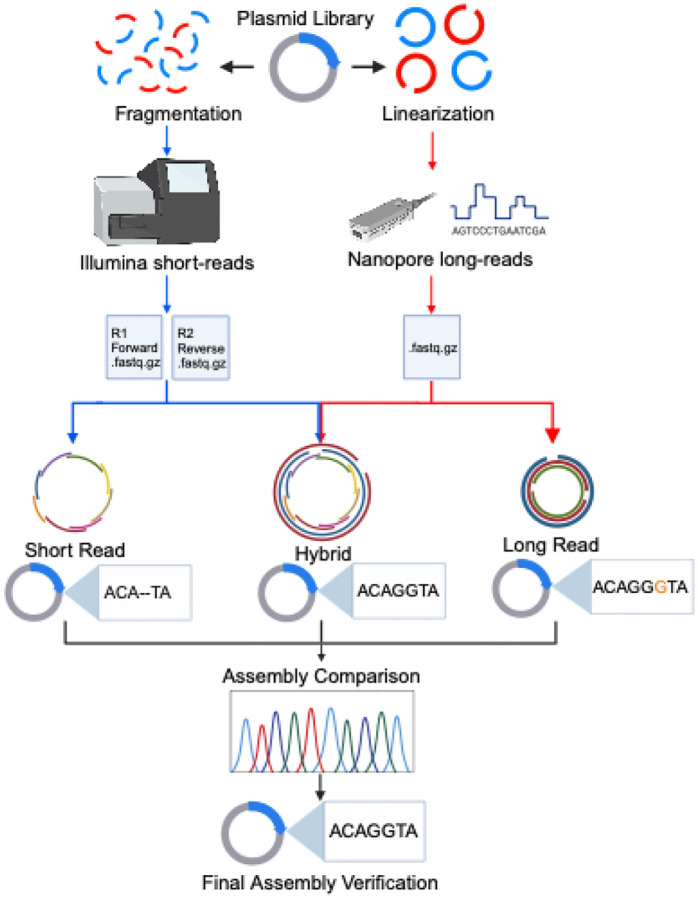
Overview of sequencing workflow. l NCBI
Sanger Sequencing for PCR Products
PCR products can be directly analyzed by Sanger sequencing when amplification generates a sufficiently clean target.
The general workflow is:
Target DNA
→ PCR
→ Amplicon verification
→ PCR cleanup
→ Cycle sequencing
→ Capillary electrophoresis
→ Sequence analysis
For difficult templates, optimizing amplification conditions before sequencing can improve the quality of the final result.
This is where approaches such as Hot Start PCR, touchdown PCR and polymerases engineered for challenging templates may provide workflow advantages.
Sanger Sequencing and GC-Rich DNA
GC-rich DNA can present difficulties during amplification because GC-rich regions may form stable secondary structures and may require careful optimization of thermal cycling conditions.
Potential optimization strategies include :
- appropriate polymerase selection
- optimized denaturation conditions
- optimized primer design
- annealing-temperature adjustment
- reaction additives when validated
- Hot Start PCR
- touchdown PCR
Generating a clean and specific PCR product before sequencing can reduce downstream chromatogram complexity.
Sanger Sequencing vs PCR : What Is the Difference?
PCR and Sanger sequencing are related molecular biology techniques, but they perform different functions.
| PCR | Sanger Sequencing |
|---|---|
| Amplifies a DNA target | Determines nucleotide order |
| Normally uses two primers | Cycle sequencing normally uses one primer |
| Produces many copies of a target | Produces terminated fragments of different lengths |
| Used for DNA amplification | Used for DNA sequence determination |
| Can be performed before sequencing | Uses purified DNA as a sequencing template |
In many laboratory workflows, the two techniques are complementary rather than competing methods.
=> PCR generates the target DNA; Sanger sequencing determines its sequence.
Sanger Sequencing vs Next-Generation Sequencing
Sanger sequencing and next-generation sequencing (NGS) serve different experimental needs.
Sanger Sequencing
Sanger sequencing is particularly appropriate for:
- targeted DNA regions
- individual plasmids
- small numbers of samples
- confirmation experiments
- defined PCR products
Next-Generation Sequencing
NGS is designed for massively parallel sequencing and is more appropriate when very large numbers of DNA fragments or genomic regions need to be analyzed simultaneously.
Therefore, Sanger sequencing remains useful even in laboratories that routinely use NGS.
The appropriate method depends on the scale, objective, sample number and required depth of the sequencing project.
Advantages of Sanger Sequencing
Important advantages include:
- well-established methodology
- straightforward analysis of targeted regions
- clear electropherogram-based visualization
- suitability for plasmid and amplicon verification
- strong utility for confirmatory sequencing
- relatively simple workflow for small numbers of targets.
Limitations of Sanger Sequencing
Sanger sequencing also has limitations.
It is less suitable for:
- massively parallel sequencing projects
- whole-genome sequencing at large scale
- highly heterogeneous DNA populations
- detection of very low-frequency sequence variants without specialized approaches
- projects requiring simultaneous analysis of thousands or millions of targets
For these applications, next-generation or other high-throughput sequencing technologies may be preferable.
Factors That Influence Sanger Sequencing Quality
Several experimental variables influence sequence quality:
DNA Template Purity
=> Contaminants may interfere with polymerase activity and electrophoresis.
Template Quantity
=> Too little or excessive DNA may reduce sequencing performance.
Primer Quality
=> Sequencing primers should bind specifically to the intended template.
PCR Specificity
=> When sequencing PCR products, non-specific amplification can produce mixed sequence traces.
Secondary Structure
=> Strong DNA secondary structures can interfere with polymerase progression.
Sequencing Reaction Cleanup
=> Residual dye terminators may generate unwanted fluorescent background.
=> Careful optimization across the complete workflow is therefore more effective than considering the sequencing reaction in isolation.
Troubleshooting Poor Sanger Sequencing Results
No Sequence or Very Weak Signal
Possible factors include:
- insufficient DNA template
- poor primer-template binding
- degraded DNA
- incorrect primer design
- inhibitors in the sample
- inefficient sequencing reaction
Multiple Peaks Throughout the Sequence
Possible causes include:
- multiple PCR products
- mixed plasmid populations
- contaminated DNA
- multiple templates in the sequencing reaction
Improving upstream amplification specificity may help when the problem originates from non-specific PCR.
Good Sequence Followed by Poor Quality
Potential causes may include:
- difficult secondary structures
- problematic sequence context
- template quality
- limitations in useful read length
An additional sequencing primer may be required when a longer DNA region must be analyzed.
Frequently Asked Questions About Sanger Sequencing
What is Sanger sequencing?
=> Sanger sequencing is a DNA sequencing technique that determines nucleotide order using DNA polymerase and chain-terminating ddNTPs. The resulting DNA fragments are separated by size, and their fluorescent signals are analyzed to reconstruct the DNA sequence.
How does Sanger sequencing work?
=> DNA polymerase extends a sequencing primer along a DNA template. Incorporation of a fluorescent ddNTP terminates strand extension. Fragments ending at different nucleotide positions are then separated by capillary electrophoresis and detected to determine the sequence.
What is the Sanger sequencing method used for?
=> Sanger sequencing is commonly used for plasmid verification, sequencing PCR products, confirming cloned DNA, analyzing targeted mutations and validating specific DNA sequences.
What is the purpose of Sanger sequencing?
=> Its purpose is to determine the nucleotide sequence of a defined DNA fragment with high-resolution sequence information.
Does Sanger sequencing require PCR?
=> Not always. Purified plasmids and other templates may be sequenced directly when sufficient suitable DNA is available. PCR is often used when a specific region must first be amplified from genomic DNA or another complex sample.
Why is PCR important before Sanger sequencing?
=> PCR can selectively amplify the region intended for sequencing. A clean, specific PCR product helps reduce mixed sequencing signals and improves subsequent sequence interpretation.
What is touchdown PCR?
=> Touchdown PCR is an amplification strategy in which the annealing temperature starts relatively high and decreases progressively over successive cycles. The approach is used to favor specific primer-template binding during early PCR cycles.
How does touchdown PCR improve specificity?
=> The higher initial annealing temperature creates stringent primer-binding conditions that favor correctly matched primer-template interactions. Once the desired product has accumulated, subsequent lower-temperature cycles can efficiently increase its yield.
Can touchdown PCR be used before Sanger sequencing?
=> Yes. Touchdown PCR can be used as an upstream amplification strategy when improved target specificity is needed before sequencing a PCR amplicon.
How do you read Sanger sequencing data?
=> Sanger sequencing results are normally examined as an electropherogram. Clear, separated peaks correspond to individual nucleotides, while overlapping or irregular peaks may indicate mixed templates, sequence heterogeneity or other technical issues.
Conclusion
Sanger sequencing remains a fundamental method for targeted DNA sequence determination. Its chain-termination principle combines DNA polymerase activity, fluorescent ddNTP incorporation and capillary electrophoresis to determine the nucleotide sequence of defined DNA fragments.
Although newer technologies provide much greater sequencing throughput, the Sanger sequencing method continues to be highly relevant for plasmid verification, PCR amplicon sequencing, cloning confirmation, targeted mutation analysis and sequence validation.
The quality of the final sequence begins before the sequencing reaction itself. When PCR amplification is required, generating a clean and specific amplicon is critical. Strategies such as Hot Start PCR and touchdown PCR can help optimize difficult amplification workflows and provide higher-quality templates for downstream Sanger DNA sequencing.
Scientific References
- Sanger F, Nicklen S, Coulson AR. DNA sequencing with chain-terminating inhibitors. Proceedings of the National Academy of Sciences of the United States of America. 1977;74(12):5463–5467. doi:10.1073/pnas.74.12.5463. Pubmed
- Hecker KH, Roux KH. High and low annealing temperatures increase both specificity and yield in touchdown and stepdown PCR. BioTechniques. 1996;20(3):478–485. doi:10.2144/19962003478. Pubmed
- Korbie DJ, Mattick JS. Touchdown PCR for increased specificity and sensitivity in PCR amplification. Nature Protocols. 2008;3(9):1452–1456. doi:10.1038/nprot.2008.133. Pubmed
- Green MR, Sambrook J. Touchdown Polymerase Chain Reaction (PCR). Cold Spring Harbor Protocols. 2018;2018(5). doi:10.1101/pdb.prot095133. Pubmed