
Cyclospora in Fresh Produce: Food Sources, Contamination Pathways and Prevention
Cyclospora Food Sources: How Fresh Produce Becomes Contaminated?
Cyclospora cayetanensis is a microscopic intestinal parasite transmitted through contaminated food or water. This scientific guide explains the common food sources of Cyclospora, how contamination can enter the fresh-produce supply chain, why outbreaks are difficult to trace and how real-time PCR supports food-safety investigations.
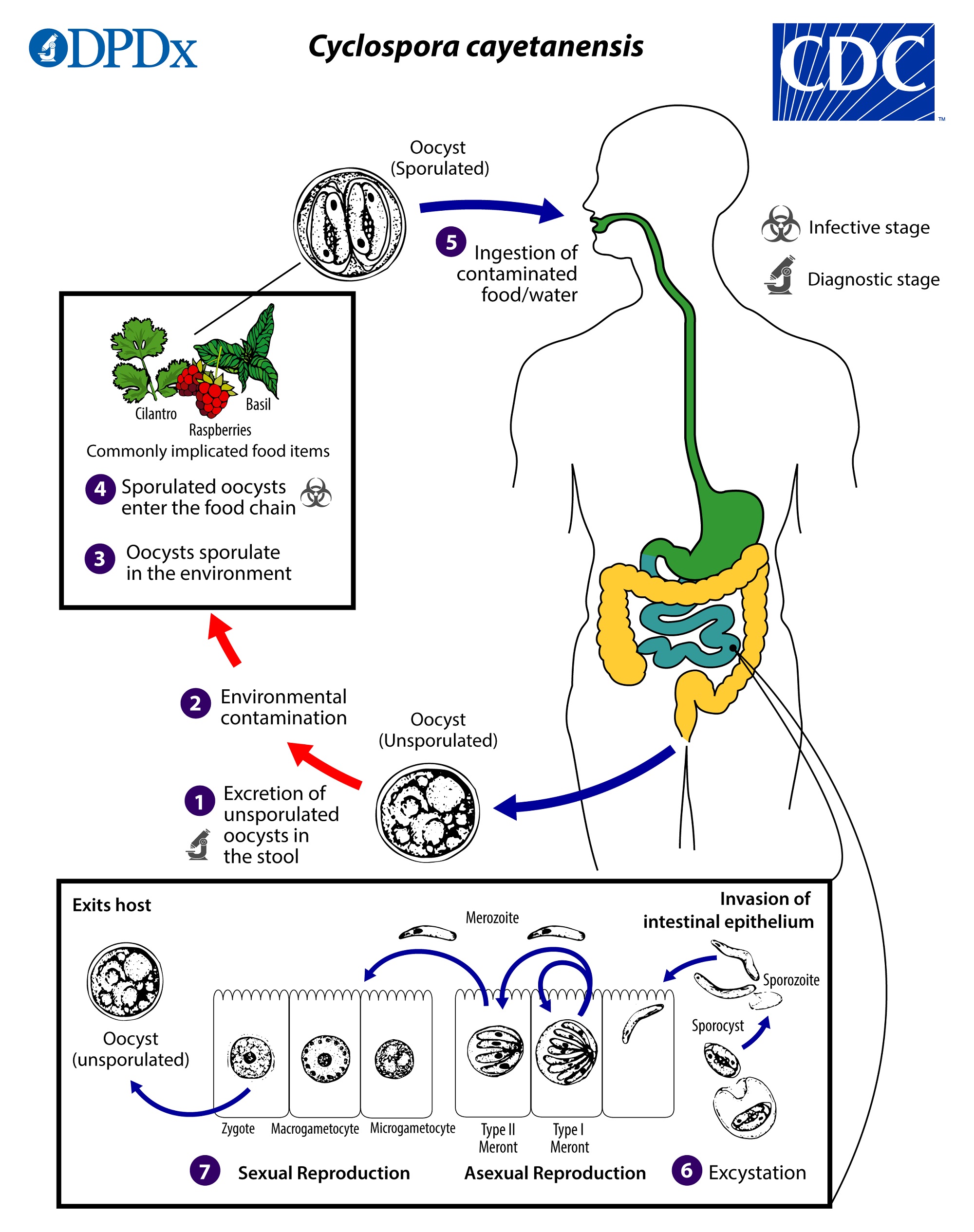
What are the common food sources of Cyclospora?
Cyclospora outbreaks have been associated with fresh produce such as lettuce, leafy greens, raspberries, basil, cilantro, parsley, cabbage, broccoli, snow peas and sugar snap peas. Contaminated drinking or agricultural water can also transmit the parasite. The risk is not limited to one specific vegetable or country; contamination depends on sanitation, water quality, worker hygiene, environmental exposure and supply-chain practices.
- Organism : Cyclospora cayetanensis
- Main transmission route : Contaminated food or water
- Common symptom : Prolonged watery diarrhea
- Food-testing method : Real-time PCR after sample processing
What is Cyclospora?
Cyclospora cayetanensis is a single-celled coccidian parasite that infects the human small intestine. The resulting disease is known as cyclosporiasis. Infection occurs when a person consumes food or water containing infectious, sporulated Cyclospora oocysts.
Cyclospora is currently believed to infect humans and to spread through human fecal contamination. However, oocysts passed in feces are not immediately infectious. They normally require time in the environment to mature or sporulate before they can cause another infection.
This environmental maturation period explains why Cyclospora is generally not transmitted immediately from one person to another. Instead, outbreaks are more commonly associated with contaminated water, fresh produce or ingredients consumed without an effective parasite-inactivation step.
Where is Cyclospora found?
Cyclosporiasis occurs worldwide but is more commonly reported in tropical and subtropical regions. Nevertheless, infections can be acquired domestically in countries with advanced sanitation systems. Fresh produce, surface water, agricultural water, wastewater and soil have all been investigated as possible environmental matrices.
A patient does not need to have travelled internationally to acquire Cyclospora. In the United States, domestically acquired cases typically increase during warmer months, and several outbreaks have been associated with produce distributed through restaurants, retailers and prepared-food supply chains.
Which foods are associated with Cyclospora?
Cyclospora is not naturally restricted to a single fruit, vegetable or herb. Food becomes a potential vehicle when it is exposed to Cyclospora-contaminated fecal material, water, soil, equipment or handling environments.
Products eaten raw receive particular attention because they may not undergo cooking or another validated treatment capable of inactivating the parasite.
| Food or environmental vehicle | Why it may be vulnerable | Relevant food-safety controls |
|---|---|---|
| Leafy greens and lettuce | Complex leaf surfaces, raw consumption and large distribution networks | Agricultural-water management, sanitation, traceability and recall readiness |
| Cilantro, basil and parsley | Often added after cooking or consumed raw as garnishes | Water-quality controls, hygienic harvesting and packing practices |
| Raspberries and other berries | Fragile and irregular surfaces make intensive washing difficult | Preventive controls during growing, harvesting and packing |
| Cabbage, broccoli and peas | May contact contaminated water, soil, workers or processing equipment | Sanitation, validated water practices and supplier controls |
| Drinking and agricultural water | Water can act as both a direct source and a vehicle for produce contamination | Source protection, treatment, monitoring and corrective action |
FDA lists raspberries, cabbage, basil, cilantro, parsley, broccoli, snow peas, sugar snap peas and leafy greens among foods previously connected with U.S. cyclosporiasis outbreaks.
An association with one commodity during a specific outbreak should not be interpreted as evidence that every product of that type is contaminated. Risk depends on the specific farm, water source, production conditions, sanitation controls, lot and distribution chain.
How does Cyclospora contaminate fresh produce?
1. Agricultural water
Water may be used for irrigation, pesticide or fertilizer application, cooling, washing and other agricultural activities. When water is affected by human sewage or inadequate sanitation, it may introduce Cyclospora oocysts onto crops or into the production environment.
Conventional microbial water indicators can help identify general fecal contamination, but an acceptable indicator-organism result does not specifically prove that Cyclospora is absent.
2. Human sanitation and worker hygiene
Because humans are the recognized source of C. cayetanensis, inadequate toilet facilities, septic-system problems, unsafe waste disposal or poor hand hygiene may contribute to environmental contamination.
Worker-hygiene controls remain important, but they must be combined with water and sanitation programs. Freshly passed oocysts require environmental maturation before becoming infectious, meaning the contamination pathway may involve more than a single handling event.
3. Soil, flooding and environmental transfer
Produce may be exposed through contaminated soil, floodwater, splashing, irrigation runoff, harvesting containers, transport equipment or packing surfaces. Moisture and environmental conditions may influence oocyst persistence and maturation.
4. Processing and distribution
Shredding, mixing or combining produce from different farms can make contamination more difficult to localize. One ingredient may be distributed to multiple restaurants, brands, retail stores or prepared meal products.
Consequently, patients in geographically separate locations may appear unrelated even though they consumed produce originating from the same supplier or growing region.
Why are Cyclospora outbreaks difficult to trace?
The incubation period delays recognition :
Symptoms commonly begin approximately one week after exposure, although onset can occur from two days to two weeks or longer. By the time a patient becomes ill, the implicated food may have been consumed, discarded or distributed to many additional locations.
Patients may not remember individual ingredients :
A person may remember eating a sandwich, salad or restaurant meal but may not remember whether it contained cilantro, lettuce, cabbage or another specific ingredient. Herbs and shredded vegetables are particularly difficult to recall because they may be concealed within a prepared dish.
Contamination may be rare and unevenly distributed :
Cyclospora oocysts may not be distributed uniformly throughout a field, production lot or food package. One laboratory sample may therefore contain detectable material while another sample from the same supply chain may test negative.
A negative food sample cannot, by itself, exclude an epidemiological relationship. Investigators evaluate laboratory results alongside patient interviews, traceback records, distribution information and environmental evidence.
The parasite cannot be routinely cultured :
Unlike many bacterial foodborne pathogens, Cyclospora cannot be grown using standard routine culture methods. Laboratories therefore rely on molecular detection, microscopy and epidemiological analysis rather than conventional culture confirmation.
How is Cyclospora detected in fresh produce?
The FDA Bacteriological Analytical Manual, or BAM, Chapter 19b describes the molecular detection of C. cayetanensis in fresh produce using real-time PCR. The current May 2026 edition includes method applicability for several produce matrices and added matrix extensions for fresh basil and parsley.
Typical analytical workflow
- Wash or process the produce sample to recover possible Cyclospora material.
- Concentrate the recovered wash debris or particulate material.
- Extract DNA using an appropriate method for the food matrix.
- Perform a species-specific real-time PCR assay.
- Review control performance and amplification characteristics before reporting the result.
The Mit1C real-time PCR target
FDA replaced the previous 18S ribosomal RNA target with the more specific mitochondrial Mit1C qPCR target for regulatory testing. A multi-laboratory study involving 13 laboratories evaluated the method using romaine lettuce samples seeded at low and high oocyst levels.
In that validation, the Mit1C method produced a 100% detection rate for samples seeded with 200 oocysts and a 69.23% detection rate for samples seeded with five oocysts. The study reported 98.9% specificity and found that Mit1C and the former 18S method had statistically similar levels of detection.
Why analytical controls are essential?
Fresh-produce extracts may contain soil components, polysaccharides, polyphenols and other substances capable of interfering with DNA recovery or amplification. A reliable workflow should therefore incorporate controls appropriate to the analytical method.
- Sample-processing or recovery control
- DNA-extraction control
- Internal amplification control
- No-template control
- Appropriate Cyclospora positive control
- Documented amplification-acceptance criteria
Cyclospora symptoms and treatment
The most characteristic Cyclospora symptom is frequent or prolonged watery diarrhea. Other symptoms may include appetite loss, weight loss, abdominal cramps, bloating, nausea, fatigue, low-grade fever and vomiting. Untreated symptoms may improve temporarily and then return.
Standard ova-and-parasite examinations may not reliably detect Cyclospora. Clinicians should specifically request Cyclospora testing when the infection is suspected.
Trimethoprim-sulfamethoxazole, abbreviated TMP-SMX, is the treatment of choice for cyclosporiasis. Patients with allergies, pregnancy-related considerations, underlying medical conditions or severe symptoms require individual medical evaluation.
For a more detailed discussion of clinical presentation, stool testing and molecular diagnosis, read: Cyclospora Outbreak 2026: Symptoms, Diagnosis and PCR Detection .
How to avoid Cyclospora?
Follow active recall notices
Do not consume a product identified in an active FDA, CDC or local public-health warning. Recalled produce should be returned or discarded according to the official instructions. Washing a recalled product does not make it suitable for consumption.
Wash produce under clean running water
Wash fruits, vegetables and herbs before eating, cutting or cooking. Remove damaged areas and scrub firm produce with a clean produce brush. Washing can reduce surface contamination but cannot guarantee complete removal of Cyclospora.
Use safe water
Safe water should be used for drinking, ice preparation, produce washing and food preparation. Agricultural operations should assess water sources, sanitation systems and potential routes of human fecal contamination.
Do not rely only on chemical sanitizers
Routine chemical disinfection or sanitization may not reliably kill Cyclospora. Prevention must therefore begin before contamination occurs, through sanitation, water-quality management, worker hygiene, environmental controls and traceability.
Cook produce when appropriate
CDC states that cooking suitable produce to at least 158°F, or 70°C, can kill the parasite. Cooking is not practical for every leafy vegetable or herb, making preventive controls especially important for foods consumed raw.
Seek medical care for persistent symptoms
People experiencing persistent watery diarrhea, dehydration, substantial weight loss or other concerning symptoms should contact a qualified healthcare professional. Suspected or confirmed cases may also need to be reported to public-health authorities.
Frequently asked questions about Cyclospora
What is Cyclospora?
=> Cyclospora is a microscopic, single-celled parasite whose scientific name is Cyclospora cayetanensis. It infects the human small intestine and causes an illness called cyclosporiasis.
What are the common food sources of Cyclospora?
=> Previous outbreaks have involved lettuce, leafy greens, raspberries, basil, cilantro, parsley, cabbage, broccoli, snow peas and sugar snap peas. Contaminated drinking or agricultural water can also transmit the parasite.
Where is Cyclospora found?
=> Cyclospora occurs worldwide and is more common in some tropical and subtropical regions. However, domestically acquired cases and contamination of domestically distributed produce can also occur.
Is Cyclospora contagious?
=> Cyclospora is not normally transmitted immediately from one person to another. Oocysts passed in feces need time in the environment to mature before becoming infectious.
Can Cyclospora be removed by washing lettuce?
=> Washing produce is recommended and may reduce contamination, but it cannot guarantee that every Cyclospora oocyst will be removed. Produce included in an official recall should not be consumed.
What are the main Cyclospora symptoms?
=> The main symptom is prolonged watery diarrhea. Other symptoms can include abdominal cramping, bloating, nausea, fatigue, appetite loss and weight loss.
What is the treatment for Cyclospora cayetanensis?
=> TMP-SMX is the treatment of choice for cyclosporiasis. Treatment should be prescribed and supervised by a qualified healthcare professional.
Can PCR detect Cyclospora in fresh produce?
=> Yes. Real-time PCR can detect Cyclospora DNA after produce washing, material concentration and DNA extraction. Analytical controls are needed to evaluate recovery, extraction and PCR inhibition.
Cyclospora contamination is a farm-to-fork food-safety problem involving human sanitation, agricultural water, environmental conditions, produce handling, processing and distribution.
Outbreak investigations are especially challenging because symptoms may begin long after exposure, patients may not remember specific ingredients and contamination may be present at low or uneven levels. Epidemiological interviews, supply-chain traceback, environmental assessment and molecular testing must therefore be interpreted together.
Reliable prevention depends on preventing fecal contamination before it reaches food. Reliable detection depends on validated sample preparation, species-specific molecular methods, appropriate quality controls and expert interpretation of amplification results.
Scientific references
- Centers for Disease Control and Prevention. About Cyclosporiasis. Updated July 14, 2026. CDC Cyclosporiasis Overview . Accessed July 20, 2026.
- Centers for Disease Control and Prevention. Preventing Cyclosporiasis. Updated July 17, 2026. CDC Prevention Guidance . Accessed July 20, 2026.
- Centers for Disease Control and Prevention. Clinical Care of Cyclosporiasis. CDC Clinical Care Guidance . Accessed July 20, 2026.
- Centers for Disease Control and Prevention. Domestically Acquired Cyclosporiasis Cases in Multiple U.S. States, 2026. Health Alert Network. CDC Health Alert Network Notice . Accessed July 20, 2026.
- U.S. Food and Drug Administration. Cyclospora. FDA Cyclospora Food-Safety Information . Accessed July 20, 2026.
- U.S. Food and Drug Administration. Investigation of Five-State Outbreak of Cyclospora Illnesses: Iceberg Lettuce, July 2026. Updated July 19, 2026. FDA Outbreak Investigation . Accessed July 20, 2026.
- Almeria S, Grocholl J, Durigan M, Ewing-Peeples L. BAM Chapter 19b: Molecular Detection of Cyclospora cayetanensis in Fresh Produce Using Real-Time PCR. May 2026 edition. U.S. Food and Drug Administration. FDA BAM Chapter 19b . Accessed July 20, 2026.
- Almeria S, Grocholl J, Mullins J, et al. Multi-laboratory validation of a modified real-time PCR assay (Mit1C) for the detection of Cyclospora cayetanensis in fresh produce. Food Microbiology. 2025;128:104727. doi:10.1016/j.fm.2025.104727. PubMed Record .
- Dixon BR, Hofstetter U, Mandeville R, et al. A scoping review of the detection, epidemiology and control of Cyclospora cayetanensis, with an emphasis on produce, water and soil. PubMed Record .