
HPLC Basics
HPLC Basics: Principles, Instrumentation, Methods, and Applications
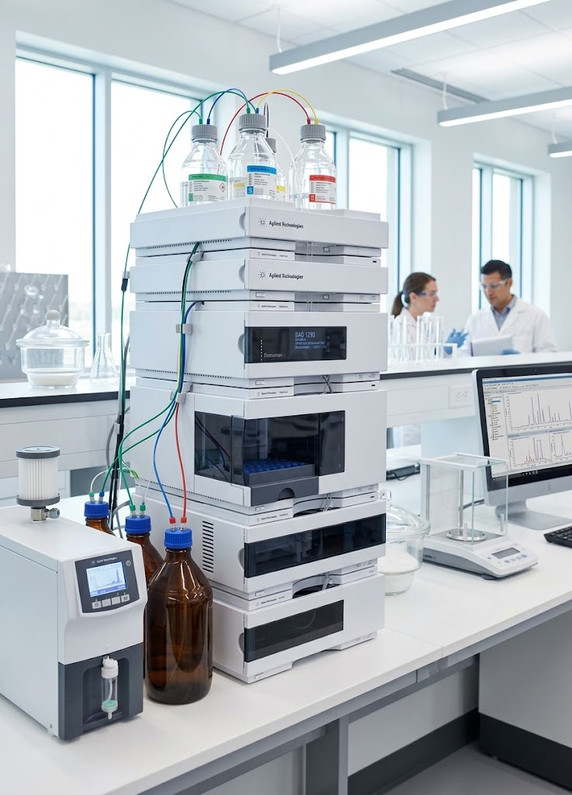
High-Performance Liquid Chromatography (HPLC) is an analytical separation technique used to identify, separate, and quantify the components of complex mixtures. It is widely applied in pharmaceutical analysis, biochemistry, biotechnology, food science, environmental monitoring, and chemical research. HPLC provides reliable analytical results when the instrument, chromatographic conditions, and analytical method are properly optimized.
1. What Is HPLC?
High-Performance Liquid Chromatography is a laboratory technique in which a liquid mobile phase transports a sample through a column containing a stationary phase. The individual compounds in the sample interact differently with these two phases, causing them to move through the column at different rates.
As the compounds leave the column, a detector measures their responses. The resulting signals are displayed as a chromatogram, which can be used to evaluate the composition of the sample and determine the concentration of selected compounds.
HPLC is particularly useful for compounds that are nonvolatile, thermally sensitive, or unsuitable for direct analysis by gas chromatography. Its versatility makes it an important tool for both qualitative and quantitative laboratory investigations.
2. Principle of HPLC
The separation principle of HPLC is based on differences in the interactions between sample components, the mobile phase, and the stationary phase.
The mobile phase is a liquid solvent or mixture of solvents that carries the sample through the chromatographic column. The stationary phase is the material inside the column that interacts with the compounds being separated.
Compounds that have weaker interactions with the stationary phase, relative to the mobile phase, generally travel through the column more quickly. Compounds that interact more strongly with the stationary phase are usually retained longer.
These differences in retention allow the components of a mixture to separate before reaching the detector.
Key concept: HPLC separation depends on the chemical properties of the analytes, the stationary-phase chemistry, the mobile-phase composition, and the chromatographic conditions.
3. Main Components of an HPLC System
An HPLC instrument contains several components that work together to perform separation, detection, and data analysis.
3.1. Solvent Reservoir
The solvent reservoir stores the mobile phase used during the analysis. Common solvents include water, methanol, and acetonitrile. Depending on the application, buffers and other additives may be included to control pH and improve separation.
The mobile phase must be compatible with the analytes, column, and detector. Solvent purity is important because contaminants can produce unwanted peaks, increase background signals, or affect column performance.
3.2. Pump
The pump delivers the mobile phase through the HPLC system at a controlled flow rate. Because the column contains tightly packed stationary-phase particles, the pump must generate sufficient pressure to maintain the required flow.
Stable flow is essential for reproducible retention times and consistent chromatographic results. Many HPLC systems also support gradient elution, in which the mobile-phase composition changes during the analysis.
3.3. Injector and Autosampler
The injector introduces a measured volume of sample into the mobile-phase stream. Manual injectors are operated by the analyst, whereas autosamplers automatically inject samples according to a programmed sequence.
Consistent injection volume is important for quantitative accuracy. Samples must be prepared appropriately to avoid introducing particles or incompatible solvents that could damage the system or distort chromatographic peaks.
3.4. Chromatographic Column
The column is the central component responsible for separating the compounds in a sample. It contains a stationary phase, often based on porous silica particles modified with specific chemical groups.
C18 columns are widely used in reversed-phase HPLC because they provide useful retention for many organic compounds. Other column chemistries are available for separating charged molecules, polar compounds, proteins, and molecules of different sizes.
Column performance depends on factors such as particle size, column length, internal diameter, stationary-phase chemistry, temperature, and mobile-phase conditions.
3.5. Detector
The detector monitors compounds as they exit the column and converts their properties into measurable signals.
- UV-Vis detector: Measures the absorption of ultraviolet or visible light by analytes.
- Photodiode array (PDA/DAD) detector: Records absorbance at multiple wavelengths and can provide spectral information.
- Fluorescence detector: Detects light emitted by fluorescent compounds after excitation.
- Refractive index detector: Measures changes in the refractive index of the eluent.
- Mass spectrometer (MS): Detects ions according to their mass-to-charge ratio and can provide information about molecular mass and chemical identity.
The choice of detector depends on the properties of the target compounds, the required sensitivity, and the analytical objective.
3.6. Data Acquisition System
The data system records the detector signal and generates a chromatogram. Chromatographic software can calculate retention times, integrate peak areas, construct calibration curves, and determine analyte concentrations.
Automated data processing improves efficiency, but the analyst must still review peak integration, calibration quality, and the validity of the results.
4. How Does HPLC Work? Step-by-Step Process
A typical HPLC analysis follows a series of steps, from sample preparation to interpretation of the final chromatogram.
- Sample preparation: The sample is dissolved or extracted using a suitable solvent. Filtration, dilution, or additional cleanup may be required.
- Mobile-phase preparation: The required solvents and additives are prepared according to the analytical method.
- System equilibration: The column is brought to stable operating conditions using the selected mobile phase and flow rate.
- Sample injection: A defined volume of sample is introduced into the flowing mobile phase.
- Chromatographic separation: The sample components move through the column and separate according to their interactions with the stationary and mobile phases.
- Detection: The separated compounds pass through the detector, generating measurable signals.
- Chromatogram generation: The software displays the detector response as a function of time.
- Data interpretation: Retention times, peak areas, peak shapes, and calibration data are evaluated to obtain analytical results.
5. Understanding an HPLC Chromatogram
A chromatogram is a graph of detector response against time. Each detectable compound may produce a peak when it passes through the detector. The number of observed peaks does not necessarily correspond to the total number of compounds in the sample, because some compounds may not be detected or may co-elute.
- Retention time: The time between injection and the selected reference point of a peak, commonly its apex.
- Peak height: The maximum detector response of a peak.
- Peak area: The integrated detector response across a peak, commonly used for quantitative analysis.
- Baseline: The detector signal outside significant analyte peaks.
- Peak width: A measure of the time span occupied by a chromatographic peak.
- Resolution: A measure of how effectively two neighboring peaks are separated.
Retention time can help support compound identification when compared with a reference standard under the same conditions. However, retention time alone is generally insufficient to establish a compound's identity conclusively.
For quantitative analysis, peak area is commonly compared with calibration standards of known concentration. The calibration model must be appropriate for the analyte and the concentration range being measured.
6. Major Types of HPLC
6.1. Reversed-Phase HPLC
Reversed-phase HPLC uses a relatively nonpolar stationary phase and a more polar mobile phase. Common stationary phases include C18 and C8, while the mobile phase often contains water mixed with methanol or acetonitrile.
Compounds that interact more strongly with the nonpolar stationary phase generally show longer retention. Reversed-phase HPLC is widely used in pharmaceutical analysis, drug development, peptide analysis, and general chemical research.
6.2. Normal-Phase HPLC
Normal-phase HPLC typically uses a polar stationary phase and a relatively nonpolar mobile phase. Separation depends on differences in interactions between analytes and the polar stationary surface.
This method can be useful for certain polar compounds, lipid-related analyses, and separations that benefit from normal-phase selectivity.
6.3. Ion-Exchange Chromatography
Ion-exchange chromatography separates compounds according to their charge and their interactions with charged groups on the stationary phase. Mobile-phase pH and ionic strength influence the charge of analytes and their retention.
This technique is used for the analysis or purification of proteins, amino acids, peptides, and other ionic compounds.
6.4. Size-Exclusion Chromatography
Size-exclusion chromatography separates molecules primarily according to their size in solution. Large molecules enter fewer pores in the stationary-phase particles and generally elute earlier than smaller molecules that can access more pores.
Applications include protein aggregation analysis, polymer characterization, and the investigation of molecular-size distributions.
6.5. Affinity Chromatography
Affinity chromatography uses specific binding interactions between a target molecule and a binding partner immobilized on the stationary phase. Separation is based on the target's affinity for that binding partner.
It is commonly used in biomolecule purification and selected protein and antibody workflows.
7. Isocratic and Gradient Elution
HPLC methods can use isocratic or gradient elution, depending on the complexity of the sample and the retention behavior of the analytes.
| Feature | Isocratic | Gradient |
|---|---|---|
| Mobile-phase composition | Constant | Changes over time |
| Typical use | Relatively simple mixtures | Complex mixtures with different retention strengths |
| Main advantage | Simple operation | Can improve separation speed and elution of strongly retained compounds |
In reversed-phase HPLC, increasing the proportion of organic solvent often increases the mobile phase's elution strength. This can help compounds that are strongly retained on the stationary phase elute more quickly.
8. Important HPLC Parameters
- Flow rate: The volume of mobile phase passing through the system per unit of time. It influences analysis time, pressure, and separation efficiency.
- Mobile-phase pH: Influences analyte ionization and can affect retention, selectivity, and peak shape.
- Column temperature: Affects solvent viscosity, retention, and chromatographic selectivity.
- Injection volume: Must be suitable for the column and method to avoid excessive sample loading or peak distortion.
- Resolution: Describes the separation between neighboring peaks.
- Column efficiency: Often expressed as the number of theoretical plates; higher efficiency generally produces narrower peaks under comparable conditions.
These parameters must be optimized together. Changing one condition may influence several aspects of chromatographic performance.
9. Applications of HPLC
Pharmaceutical Industry
HPLC is used to measure active pharmaceutical ingredients, determine drug purity, quantify impurities, and support stability testing. It is also used in the development and quality control of pharmaceutical products.
Biotechnology and Proteomics
HPLC supports the separation and characterization of peptides, selected proteins, amino acids, and other biomolecules. When coupled with mass spectrometry, it can provide additional information about molecular composition and modifications.
Food Science
HPLC can measure vitamins, preservatives, sugars, organic acids, and other food constituents. The specific method depends on the target compounds and the complexity of the food matrix.
Environmental Analysis
Environmental laboratories use HPLC methods to measure selected organic contaminants in water, soil extracts, and other environmental samples.
Clinical and Biochemical Research
HPLC is used to measure selected drugs, metabolites, and biochemical compounds in biological samples. Clinical applications require suitable validation and quality-control procedures.
10. Advantages and Limitations of HPLC
Advantages
- High separation efficiency for many complex mixtures.
- Quantitative analysis using appropriate calibration procedures.
- Compatibility with a wide range of compounds and detectors.
- Good reproducibility when the instrument and method are properly controlled.
- Compatibility with mass spectrometry for advanced chemical characterization.
Limitations
- Instrument purchase and maintenance can be expensive.
- Organic solvents and other consumables increase operating costs.
- Method development may require specialized technical expertise.
- Sample preparation can be time-consuming.
- Some compounds require specialized detectors or chemical derivatization.
11. HPLC vs. UHPLC
Ultra-High-Performance Liquid Chromatography (UHPLC) is a related technique designed to achieve efficient separations using smaller stationary-phase particles and instruments capable of operating at suitable higher pressures.
| Feature | HPLC | UHPLC |
|---|---|---|
| Particle size | Often 3–5 µm | Often approximately 1.7–2 µm |
| Pressure | Generally lower for comparable methods | Often higher |
| Analysis time | Depends on method conditions | Can be shorter with optimized methods |
The actual performance of either technique depends on column chemistry, instrument design, sample properties, and method optimization.
12. Common HPLC Problems and Troubleshooting
| Problem | Possible Cause |
|---|---|
| High backpressure | Blocked frit, contaminated column, or particulate matter. |
| Broad peaks | Excessive injection volume, extra-column dispersion, or column deterioration. |
| Tailing peaks | Secondary interactions, unsuitable pH, or column contamination. |
| Shifting retention times | Flow instability, changes in mobile-phase composition, or insufficient equilibration. |
| Unstable baseline | Bubbles, contaminated solvents, detector instability, or temperature changes. |
Troubleshooting should be performed according to the manufacturer's instructions and laboratory procedures. Never exceed the pressure limits of the instrument or column.
13. Basic HPLC Laboratory Workflow
- Define the analytical objective and select an appropriate method.
- Prepare the mobile phase and test samples.
- Install and equilibrate the selected column.
- Verify system suitability using the specified standards and acceptance criteria.
- Inject blanks, standards, quality-control samples, and test samples as required.
- Review chromatograms and integrate peaks appropriately.
- Calculate concentrations using the validated calibration model.
- Document the results and review quality-control performance.
14. Frequently Asked Questions About HPLC
What does HPLC stand for?
HPLC stands for High-Performance Liquid Chromatography, an analytical technique used to separate, identify, and quantify compounds.
What is the main purpose of HPLC?
Its main purpose is to separate the components of a mixture so that individual compounds can be detected and analyzed.
What is the difference between the mobile and stationary phases?
The mobile phase is the liquid that transports the sample through the system, whereas the stationary phase is the material inside the column that interacts with the sample components.
Can HPLC identify unknown compounds?
HPLC can support identification, but retention time alone is generally insufficient for definitive identification. Reference standards, spectral information, or mass spectrometry may provide additional evidence.
Is HPLC qualitative or quantitative?
HPLC can be used for both qualitative analysis, which investigates the identity of compounds, and quantitative analysis, which measures their amounts or concentrations.
What is the difference between HPLC and gas chromatography?
HPLC uses a liquid mobile phase and is suitable for many nonvolatile or thermally sensitive compounds. Gas chromatography uses a gas mobile phase and is particularly suitable for volatile compounds that can withstand the analytical conditions.
15. Conclusion
High-Performance Liquid Chromatography is an essential analytical technique in modern chemistry, pharmaceutical science, biotechnology, and quality control. Its ability to separate complex mixtures and quantify individual compounds makes it valuable for research, product development, and routine laboratory testing.
A clear understanding of the HPLC principle, instrument components, separation modes, chromatogram interpretation, and operating parameters provides a strong foundation for analytical work. Reliable results depend on appropriate method development, suitable standards, instrument maintenance, and validation or verification according to the intended application.
Scientific References
- Snyder, L. R., Kirkland, J. J., and Dolan, J. W. Introduction to Modern Liquid Chromatography. 3rd edition, Wiley, 2010.
- Meyer, V. R. Practical High-Performance Liquid Chromatography. 5th edition, Wiley, 2010.
- United States Pharmacopeia (USP), General Chapter <621>, Chromatography.
- International Council for Harmonisation (ICH), Q2(R2): Validation of Analytical Procedures.
Recent Posts
-
HPLC Basics
HPLC Basics: Principles, Instrumentation, Methods, and Applications High-Performance Liquid Chromat …19th Oct 2026 -
Cell Lines, Culture Types, and Cell Morphology
Cell Lines, Culture Types, and Cell Morphology: A Complete Scientific Guide Cell culture is an essen …16th Oct 2026 -
Removal of Bacterial Endotoxins
Removal of Bacterial Endotoxins : Methods, Challenges, and Best Practices in Biotechnology Introduct …15th Oct 2026