
Hydrophobic Interaction Chromatography
Hydrophobic Interaction Chromatography: Principles, Mechanism and Applications
Understanding protein separation based on surface hydrophobicity and its importance in modern protein purification, biotechnology and biopharmaceutical research.
1. Introduction to Hydrophobic Interaction Chromatography
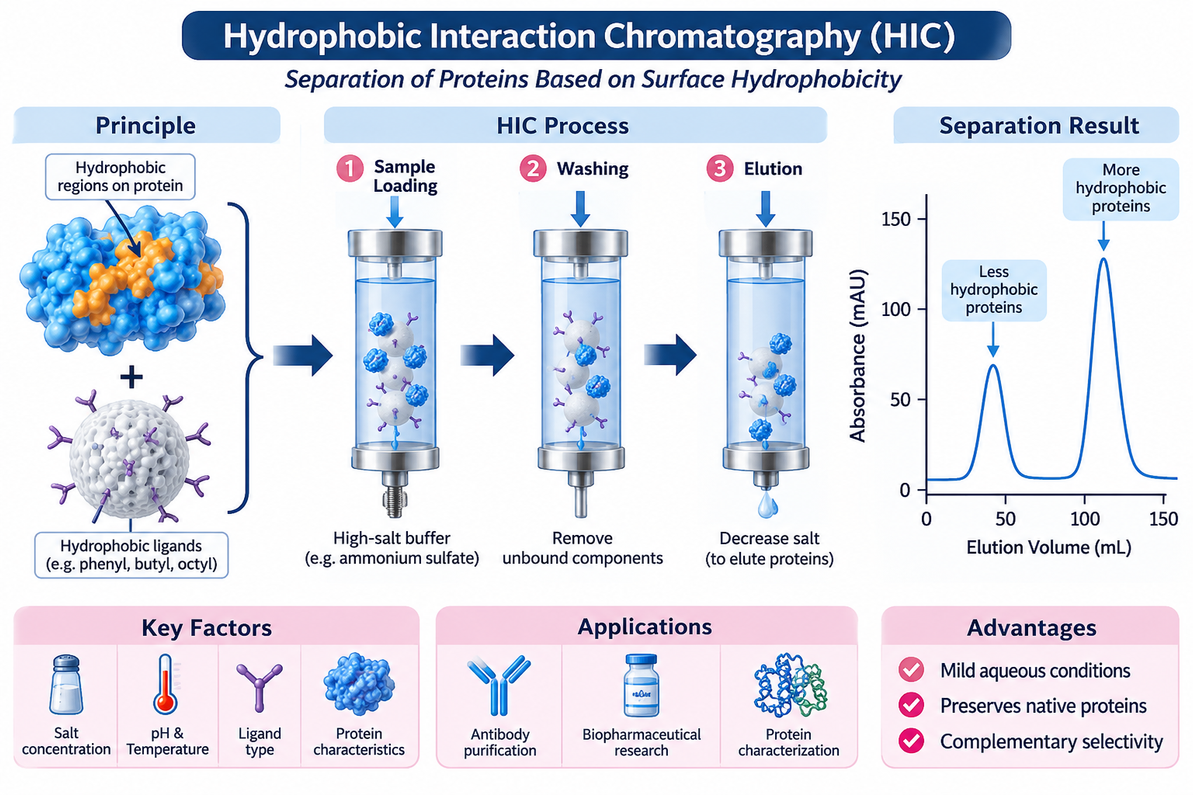
Hydrophobic Interaction Chromatography (HIC) is an important liquid chromatography technique used in biochemistry, biotechnology and pharmaceutical research. It separates proteins and other biomolecules according to differences in their surface hydrophobicity.
Proteins contain both hydrophilic and hydrophobic amino acid residues. These residues contribute to the three-dimensional structure of proteins and determine how they interact with their surrounding environment.
HIC takes advantage of these differences by using a stationary phase containing hydrophobic ligands that interact with nonpolar regions on protein surfaces. This technique is particularly valuable because separation can be performed under relatively mild aqueous conditions that help preserve native protein structure and biological activity.
2. What Is Hydrophobic Interaction Chromatography?
Hydrophobic Interaction Chromatography is a separation method based on reversible interactions between hydrophobic regions of biomolecules and nonpolar ligands attached to a chromatography support.
Common hydrophobic amino acids involved in protein surface interactions include:
- Alanine: A small nonpolar amino acid contributing to hydrophobic interactions.
- Valine: A branched-chain hydrophobic amino acid.
- Leucine: A nonpolar amino acid frequently found in hydrophobic protein regions.
- Isoleucine: Contributes to hydrophobic protein interactions.
- Phenylalanine: An aromatic amino acid with a hydrophobic side chain.
- Tryptophan: An aromatic amino acid that can contribute to hydrophobic surface interactions.
HIC stationary phases commonly contain different hydrophobic ligands, including:
- Butyl groups: Provide moderate hydrophobic interactions and are widely used in protein purification.
- Phenyl groups: Offer hydrophobic and aromatic interactions that can influence separation selectivity.
- Octyl groups: Provide stronger hydrophobic interactions and may retain highly hydrophobic proteins.
3. Principle and Mechanism of HIC
The separation mechanism of HIC depends on the interaction between protein surfaces and hydrophobic ligands immobilized on a chromatography matrix. Salt concentration plays an essential role in controlling these interactions.
Protein Binding
During sample loading, proteins are introduced into the column under high-salt conditions. Certain salts, particularly ammonium sulfate, promote hydrophobic interactions through the salting-out effect.
As the sample passes through the stationary phase, proteins with accessible hydrophobic regions interact with the immobilized ligands and become retained within the column.
Washing and Impurity Removal
After sample loading, the column is washed with an appropriate buffer to remove unbound proteins and other unwanted components.
Differences in protein hydrophobicity influence their interactions with the stationary phase, contributing to selective separation.
Protein Elution
Protein elution is generally achieved by gradually decreasing the salt concentration in the mobile phase.
As salt concentration decreases, hydrophobic interactions become weaker, allowing retained proteins to detach from the stationary phase.
Less hydrophobic proteins generally elute earlier, whereas more strongly retained proteins require lower salt concentrations for elution.
4. The Role of Salt Concentration in HIC
Salt concentration is one of the most important factors influencing hydrophobic interaction chromatography. High concentrations of suitable salts promote protein binding by enhancing hydrophobic interactions.
Ammonium sulfate is frequently used because of its strong salting-out properties. However, the choice of salt depends on protein stability, solubility and experimental conditions.
The relationship between salt concentration and protein retention can be summarized as follows:
- High salt concentration: Promotes hydrophobic interactions and protein binding.
- Intermediate salt concentration: Can influence the retention strength of different proteins.
- Low salt concentration: Weakens hydrophobic interactions and promotes protein elution.
Appropriate salt selection is essential to avoid protein precipitation, aggregation or loss of biological activity during purification.
5. Important Factors Affecting HIC Separation
Protein Surface Hydrophobicity
The distribution and accessibility of hydrophobic amino acid residues influence protein retention. Proteins with more accessible hydrophobic regions generally exhibit stronger interactions with hydrophobic ligands.
Stationary-Phase Chemistry
The nature of the hydrophobic ligand, its density and the properties of the chromatography support influence separation selectivity. Different ligand chemistries can produce different retention patterns.
Buffer Composition and pH
Buffer composition and pH can affect protein conformation, surface charge, solubility and chromatographic behavior. Conditions should be optimized to maintain protein stability.
Salt Type and Concentration
Different salts influence protein hydration and hydrophobic interactions in different ways. Selecting an appropriate salt and concentration is important for achieving efficient binding and elution.
Temperature and Flow Rate
Temperature can influence hydrophobic interactions and protein stability, while flow rate affects residence time and mass-transfer efficiency. Both parameters should be considered during method optimization.
6. Applications of Hydrophobic Interaction Chromatography
Protein Purification
HIC is widely used to separate proteins according to their surface hydrophobicity. It is frequently incorporated into multistep purification workflows alongside ion-exchange and size-exclusion chromatography.
Monoclonal Antibody Characterization
HIC is an important analytical technique for investigating monoclonal antibody variants. It can help distinguish molecular species with different hydrophobic properties, including certain product-related variants and aggregates.
Recombinant Protein Purification
Recombinant proteins produced in bacterial, yeast and mammalian expression systems can be purified using HIC when their physicochemical characteristics are suitable for this technique.
Protein Aggregate Analysis
Protein aggregates may exhibit different hydrophobic characteristics compared with their corresponding monomeric forms. HIC can therefore contribute to the characterization and separation of certain protein-related impurities.
Biopharmaceutical Research
In biopharmaceutical development, HIC supports the characterization of protein heterogeneity, hydrophobic variants and product-related impurities, contributing to the evaluation of protein quality.
7. HIC Compared with Other Chromatography Techniques
Several chromatography methods are used in protein purification. Each technique relies on a different physicochemical property to achieve separation.
- Hydrophobic Interaction Chromatography (HIC): Separates biomolecules according to surface hydrophobicity.
- Ion-Exchange Chromatography (IEX): Separates molecules based on differences in electrical charge.
- Size-Exclusion Chromatography (SEC): Separates molecules according to their hydrodynamic size.
- Affinity Chromatography: Uses specific biological interactions between a target molecule and an immobilized ligand.
- Reversed-Phase Chromatography (RPC): Separates molecules based on hydrophobicity, typically using organic mobile-phase solvents.
Although HIC and reversed-phase chromatography both involve hydrophobic interactions, their operating conditions are different. HIC generally uses aqueous buffers and relatively mild conditions, whereas reversed-phase chromatography commonly uses organic solvents that may disrupt native protein structure.
8. Advantages and Limitations of HIC
Advantages
- Uses predominantly aqueous mobile phases.
- Can help preserve native protein structure and biological activity.
- Provides separation based on protein surface hydrophobicity.
- Offers complementary selectivity to ion-exchange and size-exclusion chromatography.
- Can support protein aggregate and variant characterization.
- Suitable for analytical and preparative purification applications.
Limitations
- Requires optimization of salt type and concentration.
- High salt concentrations may cause precipitation of sensitive proteins.
- Highly hydrophobic proteins may exhibit strong retention.
- Separation performance depends on stationary-phase chemistry.
- Method development may require testing multiple experimental conditions.
9. Experimental Considerations for Successful HIC
Reliable HIC purification requires careful optimization of experimental parameters and evaluation of protein stability.
Important considerations include:
- Sample preparation: Ensure the sample is compatible with the selected binding buffer.
- Protein stability: Evaluate protein solubility and resistance to high-salt conditions.
- Column selection: Choose an appropriate hydrophobic ligand according to the target protein.
- Buffer optimization: Investigate suitable salt concentrations and pH conditions.
- Elution strategy: Optimize the decreasing salt gradient to improve separation resolution.
- Fraction analysis: Evaluate collected fractions using SDS-PAGE, analytical chromatography or other appropriate techniques.
- Purity assessment: Examine protein recovery, purity and biological activity after purification.
10. Conclusion
Hydrophobic Interaction Chromatography is a versatile separation technique that plays an important role in protein purification, biotechnology and biopharmaceutical research.
By exploiting differences in surface hydrophobicity, HIC enables the separation of proteins under relatively mild aqueous conditions. Its compatibility with other chromatographic methods makes it particularly useful in multistep purification strategies.
Understanding the effects of salt concentration, stationary-phase chemistry, buffer composition and protein surface properties is essential for developing efficient and reproducible HIC methods.
Scientific References
- Queiroz, J. A., Tomaz, C. T., & Cabral, J. M. S. (2001). Hydrophobic interaction chromatography of proteins. Journal of Biotechnology, 87(2), 143–159. https://doi.org/10.1016/S0168-1656(01)00237-1
- McCue, J. T. (2009). Theory and use of hydrophobic interaction chromatography in protein purification applications. Methods in Enzymology, 463, 405–414. https://doi.org/10.1016/S0076-6879(09)63025-1
- McCue, J. T. (2014). Use and application of hydrophobic interaction chromatography for protein purification. Methods in Enzymology, 541, 51–65. https://doi.org/10.1016/B978-0-12-420119-4.00005-7
- O'Connor, B. F., & Cummins, P. M. (2017). Hydrophobic Interaction Chromatography. Methods in Molecular Biology, 1485, 355–363. https://doi.org/10.1007/978-1-4939-6412-3_18
- Murphy, P. J. M., Stone, O. J., & Anderson, M. E. (2011). Automated Hydrophobic Interaction Chromatography Column Selection for Use in Protein Purification. Journal of Visualized Experiments, (55), 3060. https://doi.org/10.3791/3060
- Eeltink, S., et al. (2025). The current state-of-the-art approaches and emerging opportunities for hydrophobic interaction chromatography for the characterization of intact proteins and biotherapeutics. Journal of Chromatography A, 1756, 466089. https://doi.org/10.1016/j.chroma.2025.466089
Supporting Research in Protein Chemistry and Chromatography
For scientific research and educational purposes.
Recent Posts
-
Introduction to Polyacrylamide Gels
Introduction to Polyacrylamide Gels: Structure, Polymerization and Applications Understanding the …5th Nov 2026 -
Hydrophobic Interaction Chromatography
Hydrophobic Interaction Chromatography: Principles, Mechanism and Applications Understanding prote …5th Nov 2026 -
Zika Virus NS1 Protein
Zika Virus NS1 Protein: Structure, Function and Research Applications Understanding a key flavivir …4th Nov 2026