
Introduction to Polyacrylamide Gels
Introduction to Polyacrylamide Gels: Structure, Polymerization and Applications
Understanding the structure, properties and applications of polyacrylamide gels in protein electrophoresis, molecular biology and biochemical research.
1. Introduction to Polyacrylamide Gels
Polyacrylamide gels are widely used in molecular biology, biochemistry and biotechnology laboratories for separating and analyzing proteins and nucleic acids. They provide a porous three-dimensional matrix that allows biomolecules to migrate under the influence of an electric field.
One of the most important applications of polyacrylamide gels is polyacrylamide gel electrophoresis (PAGE), a technique used to separate biomolecules according to their molecular size, charge and other physicochemical properties.
Because their pore size can be controlled by adjusting the gel composition, polyacrylamide gels offer high-resolution separation and are particularly valuable in protein analysis, Western blotting and proteomics research.
2. What Are Polyacrylamide Gels?
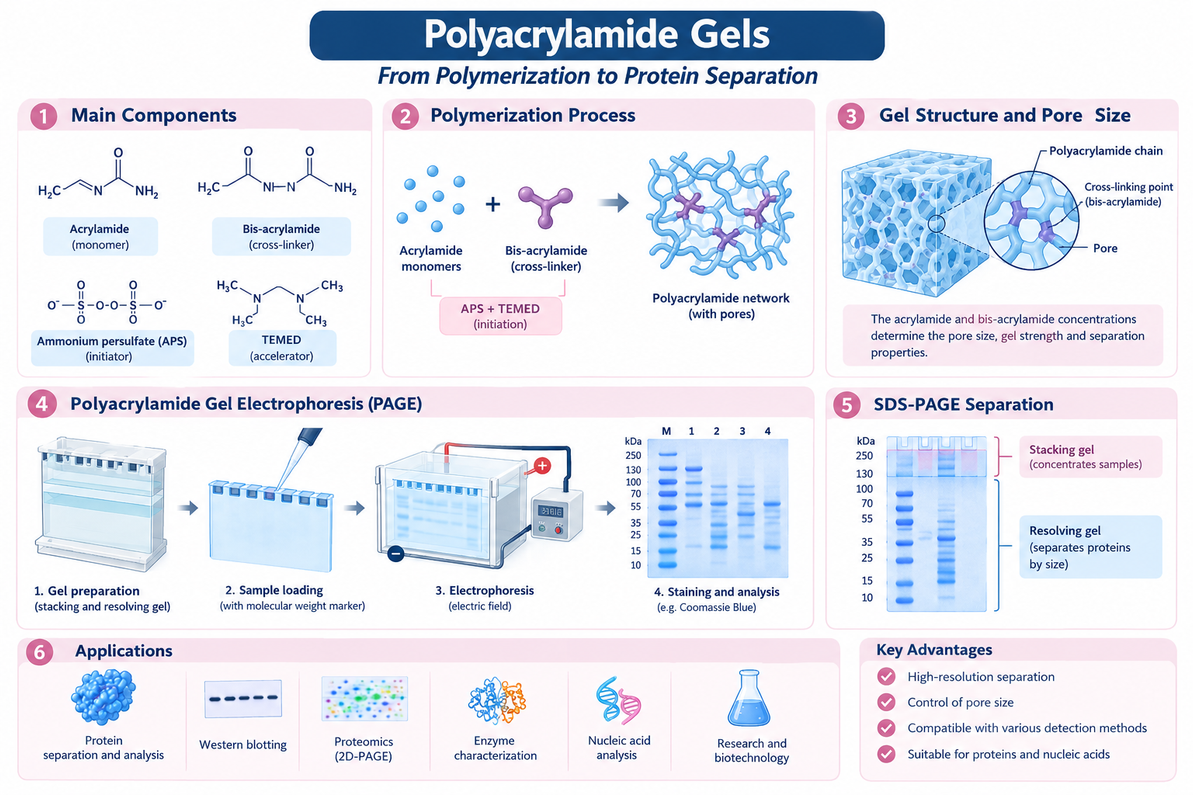
Polyacrylamide gels are synthetic polymer networks formed through the polymerization of acrylamide monomers in the presence of a cross-linking agent, commonly N,N'-methylenebisacrylamide (bis-acrylamide).
The resulting structure consists of interconnected polymer chains that create microscopic pores. These pores act as a molecular sieve, influencing how quickly different molecules migrate through the gel.
The two main components used to prepare polyacrylamide gels are:
- Acrylamide: The primary monomer that forms the polymer chains.
- Bis-acrylamide: A cross-linking agent that connects polymer chains and contributes to the formation of the gel network.
The relative concentrations of these components determine important gel properties, including pore size, mechanical strength and separation characteristics.
3. Structure and Polymerization of Polyacrylamide Gels
Polyacrylamide gel formation involves a free-radical polymerization reaction. This process converts soluble acrylamide monomers into an interconnected polymer network.
Acrylamide Monomers
Acrylamide molecules act as the building blocks of the polymer structure. During polymerization, their carbon-carbon double bonds participate in chain formation, producing long polyacrylamide molecules.
Bis-Acrylamide Cross-Linking
Bis-acrylamide contains two polymerizable groups that allow it to connect different polyacrylamide chains. This cross-linking produces a three-dimensional network with pores of different dimensions.
Ammonium Persulfate and TEMED
Ammonium persulfate (APS) acts as a free-radical initiator, while TEMED (N,N,N',N'-tetramethylethylenediamine) accelerates radical generation and promotes polymerization.
The combined action of these reagents initiates gel formation, allowing the liquid acrylamide solution to develop into a stable porous matrix.
Gel Pore Formation
The pore structure depends mainly on the total acrylamide concentration and the proportion of cross-linking agent. Adjusting these parameters allows researchers to prepare gels suitable for separating molecules of different sizes.
4. Types of Polyacrylamide Gels
Different polyacrylamide gel formats are used depending on the experimental objective and the characteristics of the molecules being analyzed.
Homogeneous Polyacrylamide Gels
Homogeneous gels contain a uniform acrylamide concentration throughout the separation matrix. They provide consistent pore characteristics and are commonly used in routine protein electrophoresis.
Gradient Polyacrylamide Gels
Gradient gels contain an increasing acrylamide concentration across the gel. This produces a gradual change in pore size and can improve the separation of proteins covering a broad molecular-weight range.
Native Polyacrylamide Gels
Native PAGE separates proteins under non-denaturing conditions. Proteins generally retain more of their native structural characteristics and biological interactions during electrophoresis.
Migration depends on several properties, including molecular size, shape and net charge.
SDS-PAGE Gels
Sodium dodecyl sulfate-polyacrylamide gel electrophoresis (SDS-PAGE) is one of the most widely used applications of polyacrylamide gels.
SDS is an anionic detergent that denatures most proteins and gives polypeptide chains a broadly similar negative charge-to-mass ratio. As a result, proteins are separated primarily according to their apparent molecular mass as they migrate through the gel matrix.
5. How Does Polyacrylamide Gel Electrophoresis Work?
Polyacrylamide gel electrophoresis uses an electric field to move charged molecules through a porous gel matrix. The gel acts as a molecular sieve, creating different migration rates according to the characteristics of the molecules.
Sample Preparation
Protein samples are prepared using an appropriate sample buffer. For SDS-PAGE, the buffer commonly contains SDS and may include a reducing agent such as dithiothreitol (DTT) or beta-mercaptoethanol to reduce disulfide bonds.
Sample Loading
Prepared samples and molecular-weight markers are introduced into wells formed at the top of the gel using a comb during polymerization.
Electrophoretic Separation
When an electric current is applied, charged molecules migrate through the gel. In SDS-PAGE, smaller polypeptides generally move more rapidly through the pores than larger polypeptides.
Protein Visualization
After electrophoresis, proteins can be visualized using staining methods such as Coomassie Brilliant Blue or silver staining. Alternatively, separated proteins can be transferred to a membrane for antibody-based detection using Western blotting.
6. Stacking Gel and Resolving Gel
Many SDS-PAGE systems use two gel layers with different compositions and pH conditions to improve protein separation.
Stacking Gel
The stacking gel is the upper layer and typically contains a lower acrylamide concentration. Its main function is to concentrate protein samples into a narrow starting zone before they enter the resolving gel.
This helps improve band sharpness and separation quality.
Resolving Gel
The resolving gel is the lower layer where most protein separation takes place. Its acrylamide concentration is selected according to the expected molecular-weight range of the target proteins.
During electrophoresis, proteins separate according to their electrophoretic mobility through the resolving gel matrix.
7. Factors Affecting Polyacrylamide Gel Performance
Acrylamide Concentration
The total acrylamide concentration influences pore size. Higher concentrations generally produce smaller pores, which can improve the separation of lower-molecular-weight proteins. Lower concentrations provide larger pores that facilitate the migration of larger proteins.
Cross-Linking Ratio
The ratio of acrylamide to bis-acrylamide affects gel structure, pore distribution and mechanical properties. Different ratios can influence the resolution of biomolecules during electrophoresis.
Buffer Composition and pH
Buffer composition and pH influence the electrical environment and migration behavior of biomolecules. Appropriate buffer systems are essential for reproducible electrophoretic separation.
Voltage and Electrophoresis Time
Applied voltage and running time influence migration speed, band resolution and heat generation. Excessive voltage can lead to overheating and distorted protein bands.
Sample Quality
Sample concentration, purity and preparation conditions can influence the final electrophoretic pattern. Overloading may result in broad or distorted bands, while degraded samples may produce unexpected protein fragments.
8. Applications of Polyacrylamide Gels in Scientific Research
Protein Molecular Weight Determination
SDS-PAGE is widely used to estimate the apparent molecular mass of proteins by comparing their migration distances with those of molecular-weight standards.
Western Blotting
Polyacrylamide gels are an essential component of Western blotting workflows. They separate proteins before transfer to a membrane, where specific antibodies are used to detect target proteins.
Proteomics Research
Polyacrylamide gel electrophoresis supports protein profiling, sample characterization and proteomic investigations. Two-dimensional PAGE combines isoelectric focusing with SDS-PAGE to separate proteins according to isoelectric point and molecular mass.
Enzyme Characterization
Native PAGE and specialized activity staining approaches can be used to investigate enzyme forms, molecular complexes and enzymatic activity under suitable experimental conditions.
Nucleic Acid Analysis
Polyacrylamide gels are also useful for separating relatively small DNA and RNA fragments with high resolution. Denaturing polyacrylamide gels containing urea are particularly useful for analyzing single-stranded nucleic acids and resolving fragments with small differences in length.
9. Advantages and Limitations of Polyacrylamide Gels
Advantages
- Provide high-resolution separation of proteins and small nucleic acid fragments.
- Allow precise control of pore size through gel composition.
- Support both native and denaturing electrophoresis.
- Are compatible with several protein detection and staining methods.
- Can be used in Western blotting and proteomics workflows.
- Support the analysis of complex biological samples.
Limitations
- Gel preparation requires careful control of polymerization conditions.
- Unpolymerized acrylamide is hazardous and requires appropriate laboratory handling.
- Some proteins may denature or lose biological activity during SDS-PAGE.
- Gel composition must be optimized for the target molecular-weight range.
- Electrophoresis conditions can influence band resolution and reproducibility.
10. Experimental Considerations and Laboratory Safety
Reliable polyacrylamide gel electrophoresis requires careful preparation, appropriate equipment and consistent experimental conditions.
Important considerations include:
- Reagent quality: Use suitable electrophoresis-grade acrylamide and cross-linking reagents.
- Polymerization: Ensure appropriate APS and TEMED conditions for consistent gel formation.
- Gel composition: Select the acrylamide concentration according to the expected molecular-weight range.
- Sample preparation: Use compatible sample buffers and appropriate protein concentrations.
- Electrophoresis conditions: Maintain suitable voltage and running time.
- Laboratory safety: Unpolymerized acrylamide is neurotoxic. Handle solutions using appropriate personal protective equipment and follow institutional chemical safety procedures.
11. Conclusion
Polyacrylamide gels are essential tools in modern molecular biology and biochemical research. Their controlled porous structure makes them particularly useful for separating proteins and small nucleic acid fragments through electrophoresis.
Understanding acrylamide polymerization, cross-linking, pore size and electrophoretic conditions is important for achieving reliable and reproducible results.
From routine SDS-PAGE analysis to advanced proteomics and Western blotting applications, polyacrylamide gels continue to support protein characterization and molecular research across many scientific disciplines.
Scientific References
- Laemmli, U. K. (1970). Cleavage of structural proteins during the assembly of the head of bacteriophage T4. Nature, 227, 680–685. https://doi.org/10.1038/227680a0
- Ornstein, L. (1964). Disc electrophoresis. I. Background and theory. Annals of the New York Academy of Sciences, 121, 321–349. https://doi.org/10.1111/j.1749-6632.1964.tb14207.x
- Davis, B. J. (1964). Disc electrophoresis – II. Method and application to human serum proteins. Annals of the New York Academy of Sciences, 121, 404–427. https://doi.org/10.1111/j.1749-6632.1964.tb14213.x
- Chrambach, A., & Rodbard, D. (1971). Polyacrylamide gel electrophoresis. Science, 172(3982), 440–451. https://doi.org/10.1126/science.172.3982.440
- Magdeldin, S., et al. (2014). Basics and recent advances of two dimensional-polyacrylamide gel electrophoresis. Clinical Proteomics, 11, 16. https://doi.org/10.1186/1559-0275-11-16
- Bass, J. J., et al. (2017). An overview of technical considerations for Western blotting applications to physiological research. Scandinavian Journal of Medicine & Science in Sports. https://doi.org/10.1111/sms.12702
- Kaplan, B. (2025). Gel Electrophoresis in Protein and Peptide Analysis: History and Current Status. Wiley Analytical Science. https://doi.org/10.1002/9780470027318.a1613.pub2
Supporting Research in Protein Chemistry and Molecular Biology
For scientific research and educational purposes. Handle unpolymerized acrylamide according to appropriate laboratory safety procedures.
Recent Posts
-
Introduction to Polyacrylamide Gels
Introduction to Polyacrylamide Gels: Structure, Polymerization and Applications Understanding the …5th Nov 2026 -
Hydrophobic Interaction Chromatography
Hydrophobic Interaction Chromatography: Principles, Mechanism and Applications Understanding prote …5th Nov 2026 -
Zika Virus NS1 Protein
Zika Virus NS1 Protein: Structure, Function and Research Applications Understanding a key flavivir …4th Nov 2026